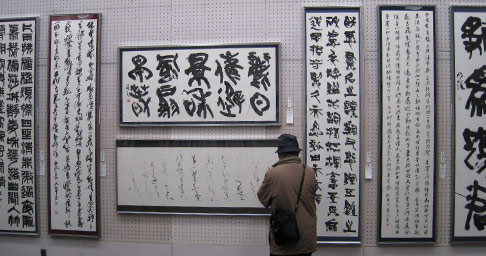
Entries Tagged as 'EAST ASIAN CALLIGRAPHY'
February 29th, 2008 · 5 Comments

Artwork from Katsushika Hokusai’s Sketchbook
Hey Blog Readers,
Below is a press release I wrote to announce that I got a Monbukagakusho Scholarship, hence the use of the third person. If the editor of the New York Times is among my readers (and I can only assume s/he is), please feel free to run this in your publication. –Lars
***********
The Future is in the Past
American Cartoonist finds Inspiration in Traditional Japanese Art
For Immediate Release
In 1833, the great Japanese artist Katsushika Hokusai wrote about his artistic development. Although seventy-three years old at the time, his ambitions were far-reaching; he predicted that by the time he was 110, his artistic skills would be so great that “every line will surely have a life of its own.”
Hokusai may have been overly optimistic about his own lifespan (he died at the age of 89), but in the opinion of Minnesota cartoonist Lars Martinson, he achieved the level of mastery to which he aspired. And Lars would like nothing more than to follow in his footsteps, albeit in a medium that didn’t even exist in Hokusai’s time: comic books. (more…)
Tags: EAST ASIAN CALLIGRAPHY · Monbusho Scholarship

Pictured: Me interperting an ancient text
At the beginning of April, I came to Japan on a Monbusho Scholarship to study Japanese Calligraphy at Shikoku University. Previous blog entries about exactly what the Monbusho Scholarship is and how I got involved in it can be found here.
Now that I’ve been here in Japan for almost two months now, I think I have enough of a sense of what the experience is shaping up to be to write an overview of what a typical week is like.
(more…)
Tags: EAST ASIAN CALLIGRAPHY · Monbusho Scholarship
As longtime readers may recall, I moved to Japan in April of 2008 to study East Asian Calligraphy at Shikoku University on a two-year research scholarship. (Newer readers can read all the sorted details starting here.)
Now as April 2009 begins and I’ve reached the halfway point of my tenure, I thought now would be a good time to show a couple examples of my calligraphy, and to write a little about the experience so far.
Regarding the calligraphy: it takes a long time to gain proficiency. I’ve read many accounts of East Asian calligraphers that started when they were schoolchildren and didn’t feel satisfied with their work until they were in their fifties or sixties. So as you might imagine, my work, the result of just one year of practice, is far from masterful. But okay, enough with the excuses, let’s take a look at it: (more…)
Tags: EAST ASIAN CALLIGRAPHY
April 10th, 2009 · 1 Comment

Pictured: Me, hard at work.
At the end of last week’s entry, I promised some big fancy announcement, so here it is: I’m writing a nonfiction prose book about my experiences studying calligraphy in Japan! The very tentative title is:
Blood, Sweat & Ink
An American Cartoonist’s Immersion into Japan’s Calligraphy Culture
When I first started thinking about it and planning it out a few months ago, I envisioned a graduation thesis of some kind. Just a short, straightforward account about how East Asian calligraphy is relevant to modern-day cartooning, to be presented to Shikoku University’s professors & students when I graduated.
But as I started getting into it and really reflecting on my experience, I saw many areas ripe for expansion. It occurred to me that if I wrote and organized it in the right way, that the subject could appeal to a general audience in the English speaking world. I’ve read several English language books about East Asian calligraphy, and have been struck by how academic and inaccesible they tend to be. It always seems to me like they’re preaching to the choir, that they’re for people who are already familiar with the subject. I’ve come to find East Asian calligraphy to be absolutely fascinating, and want to try to express that enthusiasm in a way that could be read for pleasure by laypeople. And so the idea for a book was born.
The project has become quite ambitious. It’s part autobiography, part journalism, part history, part art theory, part cultural studies…it’s quite a juggling act. Since it’s still in the early stages, I’m not sure exactly what form it will take, or how long it will be. But I’m firmly committed to it, and hope to have something done before I leave Japan in a year’s time. I’ve been pretty bad at meeting my self-imposed deadlines for comics, but maybe prose will be different, we’ll see. Right now I’m about halfway done with the rough draft.
Anyway, I’ll update and post excerpts from the book when I get a little further along, so check back, or subscribe to my RSS feed if you’re interested.
Oh, and if there’s anyone out there that’s familiar with the subject who knows of books or websites they would recommend as I continue my research, please let me know. Thanks!
Tags: EAST ASIAN CALLIGRAPHY
September 25th, 2009 · 2 Comments

About six months ago, I announced that I’m writing a book about East Asian calligraphy. I’ve continued to work on it since then, and thought I might devote a couple more blog entries to it. I’ll start off with an elaboration of why I’m writing the book in the first place.
There are already a number of informative English language books about East Asian calligraphy (such as Chinese Calligraphy [The Culture & Civilization of China] published by Yale University Press). But all of the books that I’ve come across have the same shortcoming: they read like they were written for people who already have a firm grasp of the subject.
East Asian calligraphy is a form of creative expression that doesn’t really have a Western equivalent. As such, its tenets must be explained from scratch if it is to be meaningfully understood. Most of the “introductory” books about East Asian calligraphy that I’ve read fail to provide this context. They launch straight into technical discussions about dynastic periods and picto-ideographs and script subcategories without adequately explaining the big picture. I often have a hard time making it through these books, and I’ve devoted the past eighteen months to studying the subject.
There is a real need for an English language book that introduces East Asian calligraphy in a way that is both entertaining and layperson-friendly, and it is my hope to create a book to fill this need.
Next week I’ll write a bit about what makes East Asian calligraphy unique from other art forms.
Tags: EAST ASIAN CALLIGRAPHY

Pictured: Calligraphy by Wang Hsi-Chih (shown sideways)
Last week, I stated my belief that East Asian calligraphy is a form of artistic expression that doesn’t have a true Western equivalent. I’d like to elaborate on that a bit, but first I’d like to devote an entry to lines. My studies into East Asian calligraphy have afforded me an opportunity to consider them from a whole other perspective.
Any handwritten line could be thought of as a record of energy. You move your hand over a surface, and the writing implement you’re holding leaves a trail behind recording that movement.
A number of factors affect this “energy record”, including the surface you’re writing on, the writing implement you’re using, and how your hand moves. Lines are two-dimensional, but energy changes in the third dimension affect them as well. Press down hard and you get thick, dark lines, whereas a light touch results in lines that are thin and faint. Surprising variety and nuance can be achieved in the course of a single line.
It’s easy to follow the energy trail of a short line, even if it occasionally loops over on itself:

But when lines start looping over on themselves repeatedly, or if you layer more and more lines on top of each other, their energy records become less and less discernable:

If a multitude of lines follow along the same general path, as is often the case in sketches, they might cumulatively hint at flows of energy, but these flows will be fuzzy and poorly defined:

In more chaotic arrangements of lines, like in scribbles, the energy record becomes almost completely obscured, and amounts to little more than static:

I’ll get into what this has to do with East Asian calligraphy’s uniqueness in my next entry.
Tags: EAST ASIAN CALLIGRAPHY

Flower paintings by Jan Brueghel and Jakuchu, respectively
This entry picks up right where the last one left off, so you should read that first if you haven’t already.
Traditionally, Western painters have had little interest in preserving the energy record contained in lines; in fact, they often actively worked to obscure them. Brushstrokes weren’t seen as expressions of movement, but merely a means of applying color to the canvas. Painters sought to create a realistic facsimile of the world around them, and to the service of this goal they would apply layer upon layer of paint, smearing and dabbing away lines in the process. By the time the piece was finished, a sense of the energy might be conveyed through color or composition, but the energy record the actual brushstrokes was often completely diffused.

Not Pictured: Brushstrokes
In contrast, for millennia East Asian artists have taken great care to preserve the elegant energy records that well-rendered lines contain. They work in water-based ink, which is conducive to the creation of long flowing strokes that one could never achieve with the thick oil paints of the West. The cylindrical Chinese ink brush allows for nimble movement in every direction, as opposed the clunky square-tip brushes often favored in Western painting*.

Top: Chinese Ink Brush
Bottom: Oil Paint Brush
*(To be fair, oil painters do use pointy brushes too; but I would still hold that they are generally coarser than Chinese ink brushes)
East Asian art was/is typically rendered on paper, silk, or polished stone, which provided a much smoother surface for capturing subtle energy changes than the thick, course canvas traditionally used in the West.
The aesthetic ideals and techniques used in East Asian art are also geared towards the preservation of the energy records contained in lines. Compositions tend to be simple, with extraneous details left out. This allows the energy contained in the lines of the essential components can be more clearly understood.

Going back and “touching up” lines after they’ve been written is frowned upon, to the point where it’s practically taboo. The artist has one shot to lay down elegant, powerful lines, and if they fail, then oh well, maybe next time. Touching up lines after the fact would only weaken and diffuse their power, moving them closer to the static of a scribble.
To my mind, East Asian calligraphy is the purest expression of the tenets of East Asian art. The careful, deliberate preservation of lines/energy records is a big part of what makes it unique from much of Western art, but obviously there’s more to it than that. We’ll continue next week with my thoughts about what features that make for “good” calligraphy.
Tags: EAST ASIAN CALLIGRAPHY
November 6th, 2009 · 1 Comment
I’m over the cold/flu/whatever that knocked me out last week, but this week I’ve been really busy with grant applications and rehearsals for a calligraphy performance I’m participating in. So I’m going to have to postpone the planned East Asian calligraphy entry for the forth time…
But since I just know readers are champing at the bit to read more East Asian calligraphy-related blog entries, I thought I’d use this entry to show a few photos of a rehearsal for the aforementioned performance: (more…)
Tags: EAST ASIAN CALLIGRAPHY
November 13th, 2009 · 2 Comments
Back in September I started a series of blog posts about East Asian calligraphy. Due to a number of mitigating circumstances I had to postpone the series for a few weeks, but I finally have time to come back to it now. Those who haven’t should read the previous entries in the series before this one:
1. About My East Asian Calligraphy Book
2. Thoughts about Lines
3. East vs. West
***
The subject of this entry and the next are my thoughts on what makes for “good” East Asian calligraphy.
I’ll start with an obvious disclaimer: this is all is completely subjective, and represents only my own personal opinions and tastes. It’s probably presumptuous of me to try to sum up the beauty of this 3000 year old art tradition in just a few paragraphs, especially since I’m relatively new to the field. But I figure since East Asian calligraphy doesn’t have a Western equivalent, maybe my thoughts on the subject might in some small way help the reader understand the art. In any event, take the following with a grain of salt.
So now that that’s out of the way, let’s get into the crackpot theories/sweeping generalizations:
***
Doing vs. Being
I tend to think of East Asian calligraphy in terms of a yin-yang-esque dichotomy, so I’ll start off by introducing that. This model is of my own design, but is heavily informed by similar theories I’ve been introduced to during the course of my studies.
For months I’ve been trying to think up clear, succinct terms for the two sides of my dichotomy, but so far haven’t been satisfied with anything I’ve come up with. So just to call them something, I’ve provisionally settled on Vitality and Stability. But these terms don’t really sum up what I’m trying to express, so let me describe each of them in turn.
By Vitality, I mean a quality encompassing these traits: energy, movement, spontaneity, messiness, creativity, liveliness, subjectivity, and intoxication. A visual equivalent of this quality might be a Jackson Pollock painting, with all its raw, visceral intensity.

On the other hand is Stability: form, order, balance, symmetry, consistency, predictability, sterility, objectivity, and sobriety. A visual equivalent of this quality might be Futura, the san-serif typestyle. Inspired by the German Bauhaus movement, Futura was painstakingly designed to remove any suggestion of flourish or human imperfection. The straight lines perfectly straight, all the curves are geometrically precise, and everything is uniform, even and symmetrical.

So to my mind, the beauty of East Asian calligraphy lies in how it strikes a balance between these two qualities; in the way it expresses both the uncontained excitement of a Jackson Pollock painting and the steady clinical clarity of a Bauhaus era typestyle.
When a calligrapher favors Vitality too heavily, they end up with something that, while incredibly energetic and vibrant, is in many ways was the equivalent of tv static, without any sort of clear representation or message. Go too far towards Stability, and you’ll end up with something very clear and readable, but that feels cold and clinical, with no sense of life to it.
Each of East Asian calligraphy’s five main scripts has its own answer as to where that balance should lie. Grass Script tends towards the Vitality side, Seal Script tends towards Stability, and the other three scripts, Running, Standard and Clerical, fall at various points in between.


What’s interesting is if you look at the order in which these scripts evolved. As new scripts emerged, they moved closer and closer towards a more perfect balance between Vitality and Stability.


Continued Next Week
Tags: EAST ASIAN CALLIGRAPHY

Last week I introduced my theory that the beauty of East Asian calligraphy lies in the balance it strikes between Vitality and Stability. I didn’t get much further than just introducing the theory in abstract, so for the next two entries I thought I’d go into a little more detail and provide a few specific examples of what I’m talking about. This week will focus on Vitality.
As I mentioned before, East Asian calligraphy is often divided into five main scripts:

Each script has its own aesthetic ideals & approaches to achieving balance. For simplicities sake, I’m going to focus on how Running and Standard scripts address this challenge. They were the last two scripts to evolve, and could (arguably) be considered East Asian calligraphy’s the most perfect expressions of balance between Vitality and Stability.
Expressing Vitality
As I’ve previously written, lines could be thought of as records of energy/movement. In this sense lines are, in their very essence, expressions of vitality. Calligraphers have developed a number of methods to emphasize this intrinsic quality in their work:
Right-rising
In Running and Standard scripts, horizontal lines are rarely perfectly even, but tend to rise from left to right. This tendency no doubt evolved for practical reasons; people can write more quickly and comfortably if they don’t have to worry about keeping their horizontal lines T-square perfect. But it helps to enhance the Vitality of the work as well, by creating a sense of imbalance that suggests movement.

Modulated Strokes
Early in its history, Chinese calligraphers seemed to idealize uniform line width, but as the art evolved, calligraphers began to recognize the artistic/practical advantages of varied width in creating a sense of liveliness in their work. Virtually all East Asian calligraphy is done with a brush, which more than any other writing tool allows for flowing changes in line width. By slowly pressing a brush into the paper as you move along, you can create lines that go from the width of an eyelash to an inch thick in a single movement, with dynamic results.

Invisible connections
A sense of energy/connection can be conveyed even in areas where the brush has left no mark. Take the following example:

Technically, these are three separate, distinct lines. But it is easy to see how the brush rose off and fell back into the paper in a single flowing movement. There is a sense of energy that flows from line to line that connects them as a whole.
This is an important principle in East Asian calligraphy, particularly in Running Script and Grass Script. One of my professors suggested that a character should be written in a single breath, without stopping to recharge the brush with ink. Stopping in the middle of a character would snuff out its life. It is widely believed that calligraphic works should be written in one sitting, to suggest a unified, energetic whole.

Next week’s entry will be about how a sense of Stability is achieved.
Tags: EAST ASIAN CALLIGRAPHY
Two weeks ago I put forth my theory that the beauty of East Asian calligraphy lies in the balance it strikes between Vitality and Stability. Last week I provided examples of how a sense of Vitality is achieved, so this week we’ll conclude the thought with a discussion about Stability.
As with the previous entry, I’ll focus mainly on how Standard and Running Scripts (two of East Asian calligraphy’s five major branches) address the challenge of reconciling Stability and Vitality.

Achieving Stability
I previously described Stability as a quality encompassing these traits: form, order, balance, symmetry, consistency, predictability, sterility, objectivity, and sobriety.
Stability as I’m defining it usually isn’t evoked as a positive when discussing art; you probably wouldn’t describe artwork that you liked as being “consistent” or “predictable”. But Stability is a critical component of East Asian calligraphy (and most other art forms for that matter). In the very least, characters need to be legible*, which requires consistent, predictable ways of rendering their shapes and structures.
Beyond this most basic need, it is also generally believed that good calligraphy should be well-balanced & harmoniously composed, two qualities that fall under the canopy of Stability as I’m defining it.
Structural Integrity
I didn’t really appreciate the structure of Chinese characters until I tried to recreate them myself. Below is a classic piece of calligraphy written in 653AD, and my own attempts at it:

I’ve picked a particularly dismal example of my own calligraphy (from shortly after I first started) to more clearly illustrate my point. But even now, my best efforts pale in comparison to what I’m modeling them after. My work is legible; any Chinese or Japanese person could read it. But it just doesn’t come together as a cohesive whole in the way that great calligraphy does.
The characters in the best calligraphic works appear to be structurally sound, like they could be used as the foundation of a building. That this internal stability is achieved using only a handful of precarious, unbalanced movements (i.e. the energy records that are lines) is truly remarkable.

A detailed description of how this stability is achieved is beyond the scope of this entry, so I’ll just briefly touch on a couple techniques:
Give and Take
As the Chinese written language evolved, it sought to communicate more and more complex ideas and phenomena. Many of the new characters created were combinations of previously established characters. A good example of this is how multiple instances of the character for “tree” were used to form new characters to express “forest” and “woods”:

When the characters were joined to form new characters, they were almost never just squished together without alternation. Instead, as shown above, certain strokes in each character would be lengthened or shortened, in order to accommodate each other and create a more unified whole.
Modulated Strokes
I previously wrote the modulated strokes, or lines with dynamic, varying widths, were used to create a sense of Vitality in calligraphic works.

But this technique also plays a critical role in enhancing the Stability of a work. As I wrote last time, the horizontal lines of characters written in Standard and Running Scripts tend to rise from left to right, both to facilitate ease of writing as well as to create a sense of imbalance which suggests movement:

It would at first blush seem impossible to reconcile Stability with the imbalance created by the right-rising technique. Calligraphers use fatter strokes in key places of the character, in order to ground it and introduce a sense of Stability to it.
A good example of this can be found in the character for “heaven”, shown here in four different styles of Standard Script:

As you can see, the final stroke (the one that concludes in the lower right hand corner of each example) is significantly fatter than any of the others. This helps to ground and stabilize the right side of the character, which would otherwise appear skewed due to the right-rising horizontal lines.
Using these techniques, as well as countless others, calligraphers are able to have their cake and eat it too; to create characters that suggest both Vitality and Stability at the same time.
*****
I have a couple more things I’d like to write about East Asian calligraphy, but I’d like to take a little break from it. So the entries for the next week or two will be about something else. Stay tuned!
(*Regarding the “necessity” for legibility: actually, Grass Script is sometimes so chaotic that even calligraphy experts are unable to read it, and some avant-garde calligraphers create work that is truly inscrutable. But anyway…)
Tags: EAST ASIAN CALLIGRAPHY

Last weekend my work was displayed as a part of a gallery show at the Tokushima Museum of Literature & Calligraphy.

The logo for the show, written/designed by my advisor Hiromitsu Morikami

It was a small show, with seventeen people each displaying one or two pieces.

My piece

A close-up.
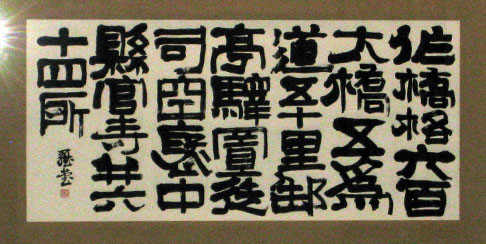
My piece was a reinterpretation of calligraphy that was carved into the side of a cliff in southern Shaanxi province, China, in 63A.D., to commemorate the opening of a pathway. Since the original calligrapher was working on a course, uneven surface, the proportions and structure of the characters is unconventional.

A rubbing of the original carving. (Detail)
Tags: EAST ASIAN CALLIGRAPHY