Introducing Pliant Press

I’ve just launched the beta version of my “business” website at:
pliantpress.com

So in recognition of that, I thought I’d devote an entry to what “Pliant Press” is, and why I created it.

******
I’ve previously written about why I want to self-publish. I figured self-publishing would be my best shot at earning a living wage through comics. Or in the very least, I would walk away from the experience having learned more about the book business than I could by any other means.

But I certainly don’t have any allusions that it’s an easy path. There are a number of hurdles that stand in between an aspiring self-publisher and a successful one. Not the least of these is the stigma that surrounds the very notion of self-publishing.


Continue reading Introducing Pliant Press

I Got Distribution!


Getting started in any business is tough, and self-publishing is no exception. One of the biggest hurtles that faces the aspiring self-publisher is that of distribution.

Most booksellers prefer to work with distributors rather than with individual publishers. Distributors tend to process and ship orders more quickly, and it consolidates the number of checks that have to be written every month (just one to the distributor, versus dozens to dozens of different publishers). There’s no way around it: you want to see your book in bookstores, getting a distributor to work with you is critical. 

Distributors, on the other hand, tend to shy away from small publishers, and especially self-publishers. They don’t want to bother with a self-publishing author who only has one book and who may never publish again. A distributor wants to develop a profitable long-term relationship with publishers that have a whole line of books. My informal research suggested that most distributors wouldn’t even consider a publisher unless they had a backlist of at least ten titles or so.

This creates a nice little catch-22. You’ll never be able to publish ten books without distribution, but you can’t get distribution unless you’ve published ten books. So what’s a first time publisher to do?

Continue reading I Got Distribution!

Creating Tonoharu #6–The Design (3/3)


Pictured: Detail of Endsheets from Tonoharu: Part One 

This is the sixth post in a series describing the creative process behind my graphic novel Tonoharu. This installment, along with the two that preceded it, deals with the design considerations. Those who haven’t already are invited to read parts one and two of the design series before diving into this one.

*****
Shading and Color:
For reasons described in the previous installment of Creating Tonoharu, I decided to omit the black borders that typically run along the edges of panels and word balloons. Without these iconic lines, it became necessary to define these areas in a different way.

Continue reading Creating Tonoharu #6–The Design (3/3)

Creating Tonoharu #5–The Design (2/3)


Pictured: A chunk of Tonoharu: Part One, page 83 

This is the fifth post in a series describing the creative process behind my graphic novel Tonoharu. This installment, along with the one that proceeded it and the one that will follow it, deals with the design considerations. Those who haven’t already are invited to read the previous entry before diving into this one.
*****

Continue reading Creating Tonoharu #5–The Design (2/3)

Creating Tonoharu #4–The Design (1/3)


Pictured: Detail from the title page of Tonoharu: Part One 

This is the forth post in a series describing the creative process behind my graphic novel Tonoharu. This installment (along with the next two) deals with the design considerations.

*****
These posts are organized so that each one addresses a different stage of my creative process, in chronological order. In practice, the stages bleed into each other so it’s not always clear where one ends and another begins, but basically my process boils down to: 1) Inspiration, 2) Writing/Editing, 3) Drawing, and 4) Editing again.

There is, however, one important element that doesn’t neatly fit into the above chronology. It began when I first started working on Tonoharu, and came to a close when I finalized production details earlier this week. That is the overall design.

I figured that this point in the Creating Tonoharu series is as good a time as any to address this unruly topic, so following are some of the design decisions I made for Tonoharu and why.

Continue reading Creating Tonoharu #4–The Design (1/3)

Creating Tonoharu #3–Writing the Script


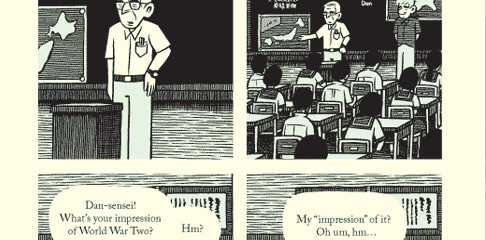
Image from Tonoharu: Part One 

This is the third post in a series describing the creative process behind my graphic novel Tonoharu. This installment deals with writing the early drafts.

******
The more I write, the more I’ve come to appreciate the subtle nuance that is a well crafted story.

The old saw “they make it look easy” applies; a well told story flows forward in such an honest and natural way that it’s easy to forget that it had an author in the first place. That behind that timeless tale of love & death was some poor schlub who struggled over countless dead-end drafts, debated with himself over what events to keep and which ones to lose, fretted over settings, timeframes, character histories, dialogue, etc., etc…

The real world doesn’t have an author (well, probably not, anyway), and a good story does such a good impersonation of Life that it’s easy to forget that there’s someone behind the curtain, pulling the strings. The more skilled an author gets, the more invisible his touch becomes.

Continue reading Creating Tonoharu #3–Writing the Script