Hood? No Good.

 
Figure 1

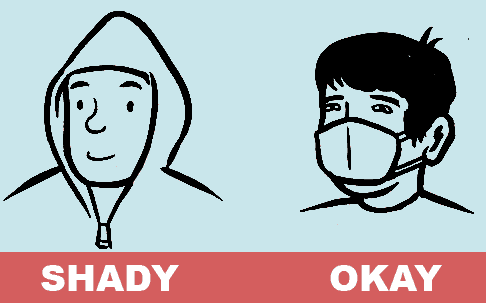
Apparently, hoods have a very negative connotation in Japan.

It was just a few weeks ago that I became aware of this, while walking to the mall with a Japanese friend. My ears started to get cold, so I put my hood on. Based on my friend’s reaction, you’d’ve thought I’d just put on a leather gimp mask.

“What are you doing??” she chirped, “Take that off!”

“Huh? Why?” I said.

“It looks suspicious!”

“Who cares? I’m freezing!” I said, leaving my hood on.

She’s short, but that didn’t stop her. She leapt up like she was shooting a free throw, and physically removed my hood. When I tried to put it back on, I got more of the same. She refused to be so much as seen with a hood-wearer.

We argued for a bit. “Are hats okay?”, I asked. She said yes. “Well, a hood is just a hat that’s attached to your jacket!” My iron-clad argument failed to win her over. Noticing she had a hood on her own jacket, I asked her what is was for. “Decoration” was her reply.

I assumed she was crazy, so I asked other Japanese friends about it, looking for backup. Much to my surprise, everyone sided with her. Even in the freezing cold dead of winter, wearing a hood is a suspicious act. None of the friends I surveyed wore the hoods attached to their jackets, no matter how cold it got.

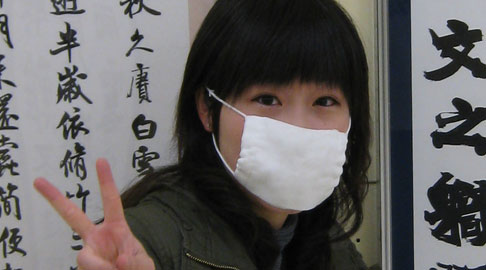
Okay, I guess every culture has its own illogical social norms, but I find the hood taboo particularly contradictory, because it’s perfectly socially acceptable in Japan to wear a surgical mask that covers up the entire lower half of your face; people often wear them to avoid catching/transmitting colds.


Figure 2

Can you imagine walking into a bank in the U.S. wearing one of these? You’d be tackled by a security guard before you made it ten steps…

Two Thousand Ten


Image from Tonoharu: Part Two

Happy New Year!

Every year since I first started this blog in 2007, I’ve written a New Year’s entry reflecting on the year that was.

As I looked over last year’s entry in preparation to write this year’s installment, I realized that not much has changed. I’m still working on the second volume of my graphic novel Tonoharu, and still attending Shikoku University on an East Asian calligraphy research scholarship from the Japanese Government.

So this year, rather than write a recap of 2009, I’ve decided to write about the year to come, as it will bring dramatic change to my life. My two-year research scholarship is nearing its end. In about three months time I’ll be packing up my things and returning to the States.

I’ll write a comprehensive reflection on the experience when the time comes, but for this entry I’ll limit my remarks to what it will mean for me financially, as this has been weighing heavily on my mind recently.

When the scholarship ends, with it will go the monthly stipend that has been covering my living expenses since April 2008. The stipend was just barely enough to get by on, but it allowed me to devote myself to my research (and cartooning) without having to worry about shrinking savings accounts or part time jobs.

With the end of the scholarship imminent, financial concerns I have been blissfully ignoring for the past twenty-odd months have returned to the forefront of my mind. I need to decide what I’m going to do once the Japanese Government stops paying my bills. This decision effectively boils down to two alternatives: looking for a “real” job, or continuing my absurd little experiment of trying to profit from my comics.

I’ll admit I’m a dreamer (no reasonable person would even consider trying to make a living as a cartoonist) but I’d like to think I’m not completely out of touch with reality. If my efforts to earn a living as a cartoonist hadn’t produced any meaningful results by now, I’d like to think I’d see the writing on the wall. I’d relegate cartooning to the status of “hobby”, and seek my fortunes elsewhere.

It’s just that there have been so many encouraging signs. I got a $10,000 grant to self-publish Tonoharu: Part One. It was mentioned in the Wall Street Journal and Entertainment Weekly. The first printing sold out in a matter of months. I got the two-year research scholarship thanks in large part to the examples of Tonoharu that accompanied my application. My comics aren’t anywhere near earning me a living wage, but I have made some money off of them. I feel that for a first-time, self published author, I’ve done quite well.

And then there are other comics-related revenue streams that I’ve been meaning to explore, which I never got around to because I was preoccupied with my research. I’d like to try selling original art and foreign publication rights. I’d like to try giving presentations/lectures about my work/Japan/East Asian calligraphy/whatever (some authors say that it’s through presentations, not book sales, that they make most of their money). In the past couple months I’ve applied for a few other art/publication-related grants, so that may bring a few bucks my way.

Also, I never really gave Tonoharu: Part One the marketing push I should’ve given it, since I left for Japan to begin my research on the same month it came out. When Tonoharu: Part Two comes out later this year (in the third or forth quarter, if you’re curious), I hope to give it the sustained marketing push that I should’ve given Part One, and see if that translates into increased sales.

So for the short term at least, I’m going to continue my foolhardy pursuit of a cartooning career. This will mean I’ll have to dip into my savings, which have already been significantly reduced by the stock market crash and breaking my ankle without insurance, but hey. You gotta follow your dreams… er… right?

You Cannot Escape the 1UP Mushroom


Direct Link

Merry Christmas Everyone!

Right off the bat I should mention that the above video won’t be of any interest to anyone who hasn’t played Super Mario 64, so you can just skip the video (and the rest of this blog entry) if you fall in that camp.

For those who are familiar with the game, an explanation of what the player is trying to do: after making the 1UP mushroom appear by climbing a tree, he tries to evade it while collecting all eight red coins, and then the star that subsequently appears. Another self-imposed rule is that he can’t enter the log cabin, as that makes the 1UP disappear (though he can use the bridge warp to get back to the top of the mountain, as the 1UP remains active in that event). If the 1UP catches him, he fails and has to start over again.

The first two minutes of the video are a little boring, but a highlight reel of his failed attempts that starts at 1:55 is pretty funny. His final, successful attempt begins at the six minute mark.

When I played Mario 64 I never really tried to run away from 1UP mushrooms, so it’s funny to see how tenacious they are in trying to catch Mario, even going through walls in their tireless pursuit. They remind me of terminators or something.

At the end of the video it says he tried for roughly nine hours before finally succeeding. Rock on, dude!

Koko the Clown in “Koko’s Conquest”


Direct Link

I hadn’t planned on posting two Koko the Clown cartoons back-to-back, but this week sort of slipped through my fingers, and I didn’t really have time to write a proper entry. Hopefully next week we’ll have something different.

Another thing I appreciate about Koko cartoons in addition to the line work is how unpredictable they are. This is true of much of the early work from the Fleischer Studios; you never really know what direction they’re going to take.

I guess you could argue that the “random for random’s sake” approach utilized in Fleischer cartoons is hardly the epitome of storytelling, but there’s something to be said for stories that actually offer genuine surprise. A friend of mine once told me that one of the reasons he liked the movie Eyes Wide Shut is because while he was watching it, he had no idea whatsoever how it was going to end. Most movies don’t have that sort of tension. When I see a typical romantic comedy I’m not really thrilled when the two leads get together in the end because there was never any doubt that they would. On the other hand, when I first saw the movie Show Me Love, *SPOILER* I was really happy when the two main characters got together in the end because it really seemed possible they might not. *END SPOILER*

So that’s why a little unexpectedness is nice to have every now and again oh my god an escaped bear just got in here and he’s eating me

Koko the Clown in “The Cure”


Direct Link

Above is a Fleischer cartoon featuring Koko the Clown, the studio’s big star until Betty Boop (and the now largely forgotten Bimbo) came along.

One thing that really impresses me about the oldest Fleischer cartoons is how strong the line work is. In modern cartoons, lines are razor-thin and uniform in width, and don’t really have any personality. The lines found in the old Koko shorts, on the other hand, have an expressive, calligraphic presence. That this quality was achieved not in still illustrations but in the labor-intensive medium of animation is pretty remarkable I think. I can’t think of any modern animation that uses lines so artfully.

Tokuyoushashosakuten

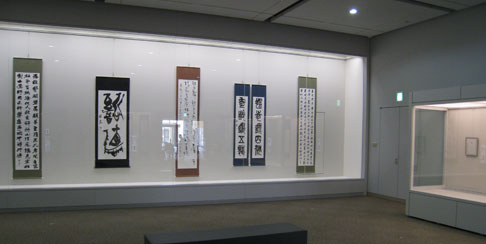
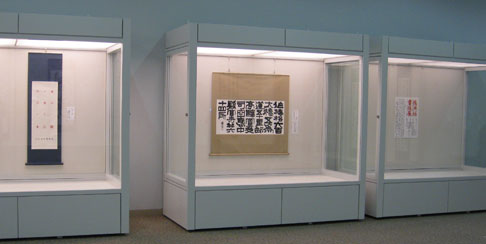
Last weekend my work was displayed as a part of a gallery show at the Tokushima Museum of Literature & Calligraphy.


The logo for the show, written/designed by my advisor Hiromitsu Morikami

It was a small show, with seventeen people each displaying one or two pieces.


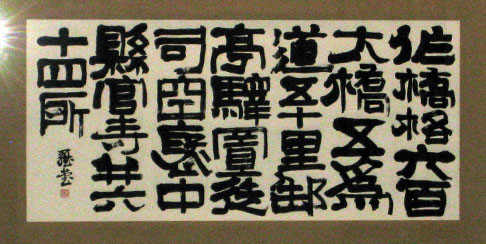
My piece


A close-up.

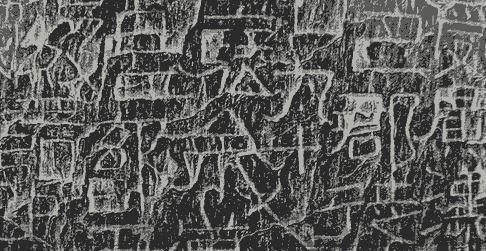
My piece was a reinterpretation of calligraphy that was carved into the side of a cliff in southern Shaanxi province, China, in 63A.D., to commemorate the opening of a pathway. Since the original calligrapher was working on a course, uneven surface, the proportions and structure of the characters is unconventional.


A rubbing of the original carving. (Detail)