The following interview ran in the French magazine Standard. It was translated into French (obviously), so the original English version has never been published. The interviewer, Jean-Emmanuel Dubois, was kind enough to allow me to put up the English version here. So here it is:
To what extent Daniel Wells is you?
I share some qualities with the character. Like Dan I’m introverted and somewhat socially awkward. And the situation I put him in—working as an assistant English teacher at a rural Japanese junior high school—was in large part based on my own experience. But I wouldn’t say Dan is an avatar for myself, contrary to what many readers seem to believe. I borrowed from aspects of my own personality in creating the character, but that’s true for all the characters in the book.
To you ever think of going back to Japan? Where do you live now and why?
Right now I live in Minneapolis, USA. It’s where I was raised, and serves as a “home base” of sorts between trips abroad. I’ll be heading back to Japan this July. In the past decade I’ve spent as much time in Japan as I have in the States, and it really feels like a second home now.
Is the town you live in was touched by the earthquake, the Tsunami and the Fukushima disaster? Do you still have contacts in Tonoharu? If so what did they told you?
I lived primarily in central and southern Japan, which was far enough away to escape the devastation. My friends in Japan were distraught over the events (as we all were) but thankfully no one I knew was injured.
Why did you decide not to translate what the Japanese people were saying?
Originally I planned to include translations, but as I looked over the script I realized it worked better without them. Leaving the Japanese untranslated more viscerally expresses the sense of profound isolation you experience when you literally have no idea what everyone around you is saying.
What’s your favorite comics or mangas about expatriate people or about exile or exodus?
One of the main reasons I originally wanted to create Tonoharu was because of the dearth of comics (and movies and tv shows for that matter) that tackled the experience of living abroad in an honest way. I hoped Tonoharu would help fill that gap. Since then I’ve become aware of a few good comics that deal with the expat experience; the work of Joe Sacco and Guy Delisle comes to mind.
Did you suffer during your stay in Japan of anti-American feelings? Did you meet any Japanese expatriate in the USA and did their friends and family blamed them to go to settle down in a historical enemy land?
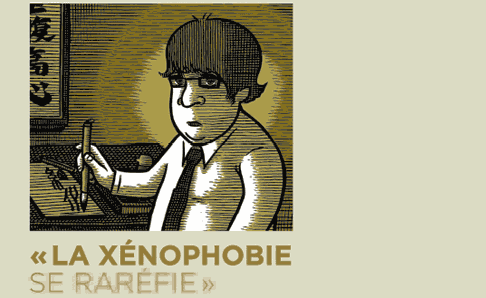
Other American expats would sometimes complain that old Japanese ladies would glare at them on the train or whatever, but I personally never really noticed a strong anti-American/anti-foreigner sentiment. There was a Japanese guy who worked at my board of education who was always trying to talk to me about American military bases in Japan, but I never sensed hostility from him per se (just a creepy intensity). Likewise, I can’t think of any Japanese friends who’ve lived in the US who got flak about it. I think those xenophobic prejudices are becoming rarer, especially among members of the younger generations. I guess my grandmother was really surprised when I described how well I was treated in Japan. I think her understanding of the country was mostly informed by World War II propaganda, which paints a distorted picture to say the least.
In the first volume the relationship with the Japanese teacher seems a bit awkward and at the same time some American male are quite sexist toward Japanese women-What was in real life your relationship and your love life with Japanese women? What did you learn? What are the main differences between US males & Japanese women in your opinion?
Japanese society is still quite male-centric; the whole “ladies first” idea was never a part of the traditional culture. Japanese men expect a measure of deference from their girlfriends and wives that would be considered unacceptable in the West. So I think Japanese women tend to idealize American and European men, imagining them to be chivalrous romantics. Some Western men take advantage of this rose-colored perception to lascivious ends. I’d like to think that I wasn’t among them, but I’ll admit that it made dating easier. All I had to do was open a door or do the dishes every once in a while, and it was like I was Prince Charming.
What’s your main graphic & storytelling influences?
My influences are probably pretty predicable to anyone who knows even a little about alternative comics and cinema. On the comics side, Chris Ware, Seth and Daniel Clowes have all played a big role. For movies, I’m a big fan of Wong Kar-wai and the Coen Brothers, and their work has probably had some influence on my own. Like I say, pretty predictable.
Your comic is very sophisticated and graphically follow a lot of rules (like all the panels getting the same size, no black borders) what make you follow that path?
My overriding design principle was trying to maximize readability. I try to keep things consistent and straightforward unless there was a good reason for deviation. Readability isn’t sexy, but it’s important for longer books. Some comics have flashy layouts and character designs that look good, but don’t read good. Reading them is actually tedious. For Tonoharu, I didn’t want the format and presentation of the book to take precedent over its content.
What’s your comic projects for the future?
Once Tonoharu is done I want to write a non-fiction comic about East Asian calligraphy. From 2008 to 2010 I studied it at Shikoku University, and was amazed by how deep and unique the discipline was. I’ve come to believe that East Asian calligraphy is the world’s most sophisticated inking tradition, and that cartoonists and illustrators of all stripes could benefit enormously from its study.
There are already a number of informative books about East Asian calligraphy in English, but they tend to be very dry and academic. So I’m hoping to write something that serves as a fun introduction that could be enjoyed by laypeople.
Did some Japanese people read your graphic novel and how did they react?
Most of my acquaintances in Japan aren’t fluent in English, so I haven’t had much of an opportunity to discuss the content of the book with them.
That said, most were surprised by the look and format of the book. Japanese manga is much more standardized than American comics, both in terms of style and presentation. In the US, comics are marginalized enough that creators can seek their own path without needing to worry too much about reader expectations or editorial interference. Because of this, I think you see more diversity in American comics. Since most Japanese people have never read a non-Japanese comic, they were often surprised because Tonoharu doesn’t conform to their expectations for the medium.
Will you agree if i say to you there’s also an influence of European comics in Tonoharu?
I have to admit I’m fairly ignorant when it comes to European comics. As a kid I read some Tintin, and no doubt Hergé’s ligne claire art style has had an effect on my work. I’m also a big fan of the Norwegian cartoonist Jason. His panel transitions are among the most economical and artful that I’ve seen, and I hold them up as an example to be emulated.