I’ve been sick for most of this week, so I didn’t have the energy to write the calligraphy blog entry I had planned; hopefully I should be feeling better by next week, and will post it then. Sorry!

Updated Every Monday.
I’ve been sick for most of this week, so I didn’t have the energy to write the calligraphy blog entry I had planned; hopefully I should be feeling better by next week, and will post it then. Sorry!

In creating Tonoharu, one of my main objectives was to faithfully portray Japan as I experienced it during my three year tenure as an assistant English teacher in the JET Program.
Tonoharu: Part One took place almost exclusively in rural areas. In Part Two, city scenes start to pop up for the first time. So I thought for this artwork preview, I’d show a few of those panels:

It was fun to draw different settings from Part One, but at the same time, city scenes are horribly complicated, meaning every panel took that much longer to draw. The above images probably explain better than words why Part Two is taking so long to draw… I’ll finish it eventually…
I’ll probably have another artwork preview when I write the next progress report a few months from now. In the meantime, this entry has artwork from some of Tonoharu: Part Two‘s action scenes.

Progress Bar Key
Manuscript/Story: The Story/Script for the comic
Artwork: The Drawing, Inking, and Computer Work for the comic
Final Edits/Incidentals: Post-Production Edits, Designing the Cover, Preparing for Press, etc.
(More information about Tonoharu can be found here.)
****
Hurray! The artwork for Tonoharu: Part Two is now more than 4/5ths done! I’ve rounded third and am heading for home!
After I finish the final 15% of the artwork, there’s still post-production edits and incidentals, but I don’t anticipate them to take as long as for Tonoharu: Part One. For that book, practically every single panel went through significant graphical edits (as outlined in this blog entry), and it took months and months of tedious work.
But I’ve improved my batting average since then, so for Part Two, I’ll probably edit some panels in this manner, but not nearly as many. I’m thinking maybe 25%-50% of the panels will go under the knife (hopefully on the lower end of that). We’ll see how effectively I can curtail my perfectionist instincts.
I’m anticipating a late 2010 release. I’ll keep you posted…
We’ll bring this entry to a close with a couple fun facts about this book:
I’m promised some more artwork samples from Tonoharu: Part Two with this progress report, and will post those next week. So stay tuned!
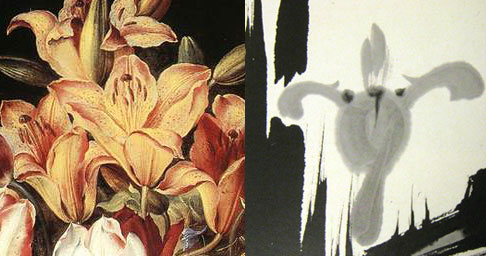
Flower paintings by Jan Brueghel and Jakuchu, respectively
This entry picks up right where the last one left off, so you should read that first if you haven’t already.
Traditionally, Western painters have had little interest in preserving the energy record contained in lines; in fact, they often actively worked to obscure them. Brushstrokes weren’t seen as expressions of movement, but merely a means of applying color to the canvas. Painters sought to create a realistic facsimile of the world around them, and to the service of this goal they would apply layer upon layer of paint, smearing and dabbing away lines in the process. By the time the piece was finished, a sense of the energy might be conveyed through color or composition, but the energy record the actual brushstrokes was often completely diffused.
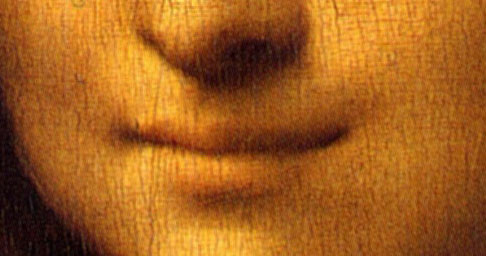
Not Pictured: Brushstrokes
In contrast, for millennia East Asian artists have taken great care to preserve the elegant energy records that well-rendered lines contain. They work in water-based ink, which is conducive to the creation of long flowing strokes that one could never achieve with the thick oil paints of the West. The cylindrical Chinese ink brush allows for nimble movement in every direction, as opposed the clunky square-tip brushes often favored in Western painting*.
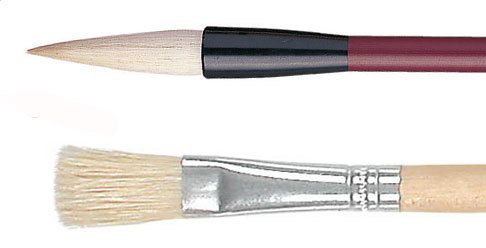
Top: Chinese Ink Brush
Bottom: Oil Paint Brush
*(To be fair, oil painters do use pointy brushes too; but I would still hold that they are generally coarser than Chinese ink brushes)
East Asian art was/is typically rendered on paper, silk, or polished stone, which provided a much smoother surface for capturing subtle energy changes than the thick, course canvas traditionally used in the West.
The aesthetic ideals and techniques used in East Asian art are also geared towards the preservation of the energy records contained in lines. Compositions tend to be simple, with extraneous details left out. This allows the energy contained in the lines of the essential components can be more clearly understood.
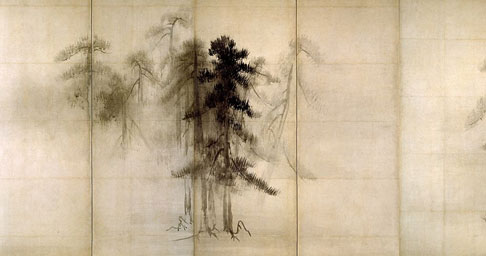
Going back and “touching up” lines after they’ve been written is frowned upon, to the point where it’s practically taboo. The artist has one shot to lay down elegant, powerful lines, and if they fail, then oh well, maybe next time. Touching up lines after the fact would only weaken and diffuse their power, moving them closer to the static of a scribble.
To my mind, East Asian calligraphy is the purest expression of the tenets of East Asian art. The careful, deliberate preservation of lines/energy records is a big part of what makes it unique from much of Western art, but obviously there’s more to it than that. We’ll continue next week with my thoughts about what features that make for “good” calligraphy.
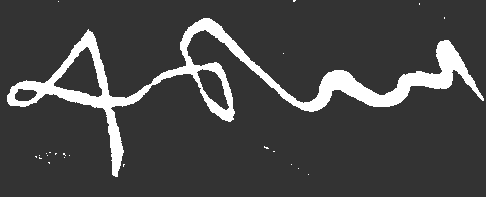
Pictured: Calligraphy by Wang Hsi-Chih (shown sideways)
Last week, I stated my belief that East Asian calligraphy is a form of artistic expression that doesn’t have a true Western equivalent. I’d like to elaborate on that a bit, but first I’d like to devote an entry to lines. My studies into East Asian calligraphy have afforded me an opportunity to consider them from a whole other perspective.
Any handwritten line could be thought of as a record of energy. You move your hand over a surface, and the writing implement you’re holding leaves a trail behind recording that movement.
A number of factors affect this “energy record”, including the surface you’re writing on, the writing implement you’re using, and how your hand moves. Lines are two-dimensional, but energy changes in the third dimension affect them as well. Press down hard and you get thick, dark lines, whereas a light touch results in lines that are thin and faint. Surprising variety and nuance can be achieved in the course of a single line.
It’s easy to follow the energy trail of a short line, even if it occasionally loops over on itself:
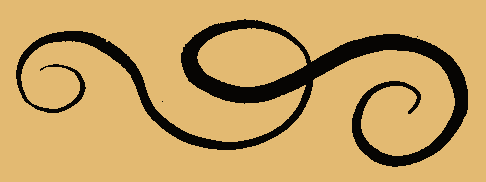
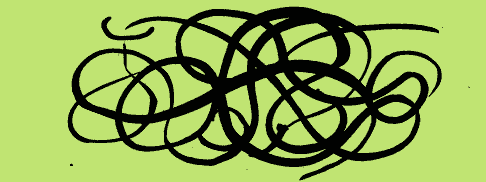
But when lines start looping over on themselves repeatedly, or if you layer more and more lines on top of each other, their energy records become less and less discernable:
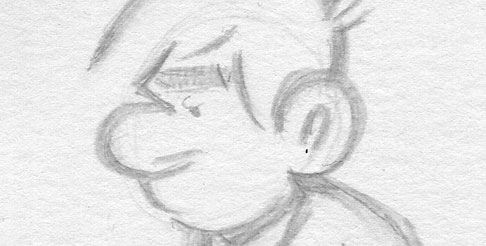
If a multitude of lines follow along the same general path, as is often the case in sketches, they might cumulatively hint at flows of energy, but these flows will be fuzzy and poorly defined:
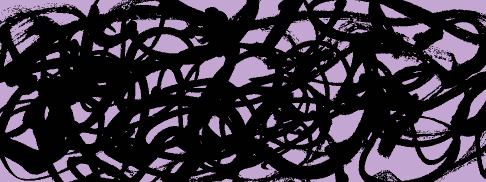
In more chaotic arrangements of lines, like in scribbles, the energy record becomes almost completely obscured, and amounts to little more than static:
I’ll get into what this has to do with East Asian calligraphy’s uniqueness in my next entry.