
Thoughts about Lines


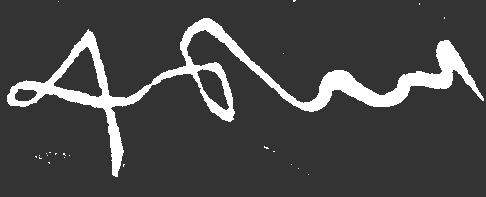
Pictured: Calligraphy by Wang Hsi-Chih (shown sideways)

Last week, I stated my belief that East Asian calligraphy is a form of artistic expression that doesn’t have a true Western equivalent. I’d like to elaborate on that a bit, but first I’d like to devote an entry to lines. My studies into East Asian calligraphy have afforded me an opportunity to consider them from a whole other perspective.

Any handwritten line could be thought of as a record of energy. You move your hand over a surface, and the writing implement you’re holding leaves a trail behind recording that movement.

A number of factors affect this “energy record”, including the surface you’re writing on, the writing implement you’re using, and how your hand moves. Lines are two-dimensional, but energy changes in the third dimension affect them as well. Press down hard and you get thick, dark lines, whereas a light touch results in lines that are thin and faint. Surprising variety and nuance can be achieved in the course of a single line.

It’s easy to follow the energy trail of a short line, even if it occasionally loops over on itself:
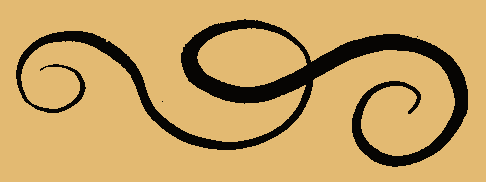
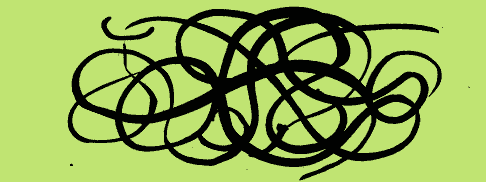
But when lines start looping over on themselves repeatedly, or if you layer more and more lines on top of each other, their energy records become less and less discernable:
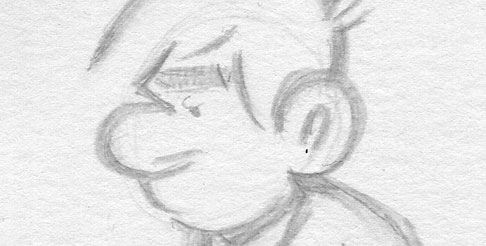
If a multitude of lines follow along the same general path, as is often the case in sketches, they might cumulatively hint at flows of energy, but these flows will be fuzzy and poorly defined:
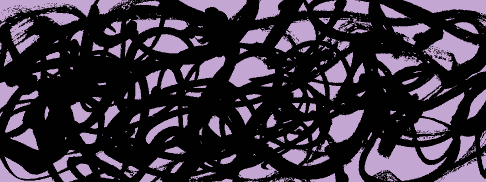
In more chaotic arrangements of lines, like in scribbles, the energy record becomes almost completely obscured, and amounts to little more than static:
I’ll get into what this has to do with East Asian calligraphy’s uniqueness in my next entry.
About My East Asian Calligraphy Book

About six months ago, I announced that I’m writing a book about East Asian calligraphy. I’ve continued to work on it since then, and thought I might devote a couple more blog entries to it. I’ll start off with an elaboration of why I’m writing the book in the first place.

There are already a number of informative English language books about East Asian calligraphy (such as Chinese Calligraphy [The Culture & Civilization of China] published by Yale University Press). But all of the books that I’ve come across have the same shortcoming: they read like they were written for people who already have a firm grasp of the subject.

East Asian calligraphy is a form of creative expression that doesn’t really have a Western equivalent. As such, its tenets must be explained from scratch if it is to be meaningfully understood. Most of the “introductory” books about East Asian calligraphy that I’ve read fail to provide this context. They launch straight into technical discussions about dynastic periods and picto-ideographs and script subcategories without adequately explaining the big picture. I often have a hard time making it through these books, and I’ve devoted the past eighteen months to studying the subject.

There is a real need for an English language book that introduces East Asian calligraphy in a way that is both entertaining and layperson-friendly, and it is my hope to create a book to fill this need.

Next week I’ll write a bit about what makes East Asian calligraphy unique from other art forms.

Interesting Inking Technique

Direct Link

Comics are big business here in Japan, which has led to standardization in their creation and distribution. The vast majority are the same size, and in black & white. Even artistically, they’re pretty homogenized (within their respective genres). All boys comics look the same, all girls comics look the same… even “weird” comics all tend to look weird in the same way.

One thing I like about American “alternative” (i.e. “non-superhero”) comics is that they are obscure enough that a standardized way of creating them has never really emerged. This forces every cartoonist to reinvent the wheel, but it’s good in that it leads to a lot of artistic diversity; much more so than in Japan, even though comics are a million times more popular here.

Apropo of all that, the above clip is probably the weirdest inking method I’ve ever seen. Does that guy really draw all his comics that way? I dunno, but it’s pretty cool.

Via Neatorama

She Can Win You With A Wink

Direct Link

Above is one of my favorite Betty Boop cartoons. It gets particularly good at around the five minute mark, and wraps up with one of the most bizarre, non-sequester endings I’ve ever seen in any cartoon/movie/comic book.

Betty Boop is an interesting case. She’s almost universally known, but most people have never seen any of her cartoons. I bet people would be surprised by how weird they are. These days, Betty exists only to sell mundane, crappy mall merchandise.

Japan has a lot of characters like this. The grand daddy of them all is of course Hello Kitty, the character equivalent of Helvetica, so generic that it/she can remain in style decade after decade. Snoopy is also big here in Japan, but most people don’t know he comes from a comic strip. Stitch from the Disney movie Lilo and Stitch is also big, but I doubt most people have seen the movie he comes from…

Mad Libs-esque Pringles Flavor

Pringles is always releasing new flavors in Japan. It seems like every month a couple flavors are added and a couple others are retired.

I guess it must be hard coming up with new concepts or whatever, but Old American Circus: Funky Mustard? What the hell does that even mean?

My guess is that they had a hat filled with adjectives, nouns, & flavors, and just pulled random words from it.

“Old American Circus: Funky Mustard”… What a world.

Mario “Collectable”

One of my favorite stores in Japan is called Village Vanguard. It’s a weird and yet somehow harmonious mix of alternative book store and raunchy mall gift shop.

When I went there the other day, I ran across the above product, which is basically one of those parachuting army men toys, only Mario branded.

If you look closely, it’s a kid’s meal toy from Wendy’s.

Mario is owned by Nintendo, which is of course a Japanese company, so I find it funny that they’re importing Mario products from other countries (and crappy Mario products at that). For the kitsch value, I guess? Apparently kitsch value is pretty high, because they’re trying to sell these pieces of garbage for 714 yen, or like $7.50. Yikes!

Though it is vintage; the copyright says 2004, which means that these have been sitting around in a warehouse somewhere for like five years. I wonder what weird distribution network eventually led these to a trendy Japanese chain.